
Near Lake Paravani, Georgia
About 24 km west-south-west of Tsalka · 51 km from our Shaghik station
- Date19 November 2026
- Time07:56 local · 03:56:08 UTC
- MagnitudeML 2.7
- Epicentre41.487° N, 43.844° E
Located by the CHARNET network, IGES · 7 stations
At 07:56 local time on 19 November, a small earthquake of magnitude ML 2.7 occurred in southern Georgia, near Lake Paravani in the Javakheti highland, about 24 kilometres west-south-west of Tsalka and some 40 kilometres north of the border with Armenia. Seven CHARNET stations in Armenia were used to locate it, from Shaghik, 51 km away, to Elpin, 213 km away.
The epicentre lies outside our network, to the north of Armenia, so all our stations see it from one side. That makes the location less precise than for earthquakes inside the country, and the depth, about 10 km in our solution, is poorly constrained.
The epicentre (star) near Lake Paravani and the seven CHARNET stations used to locate the earthquake. Hover over a station for its distance and S–P time.
between the P- and S-waves
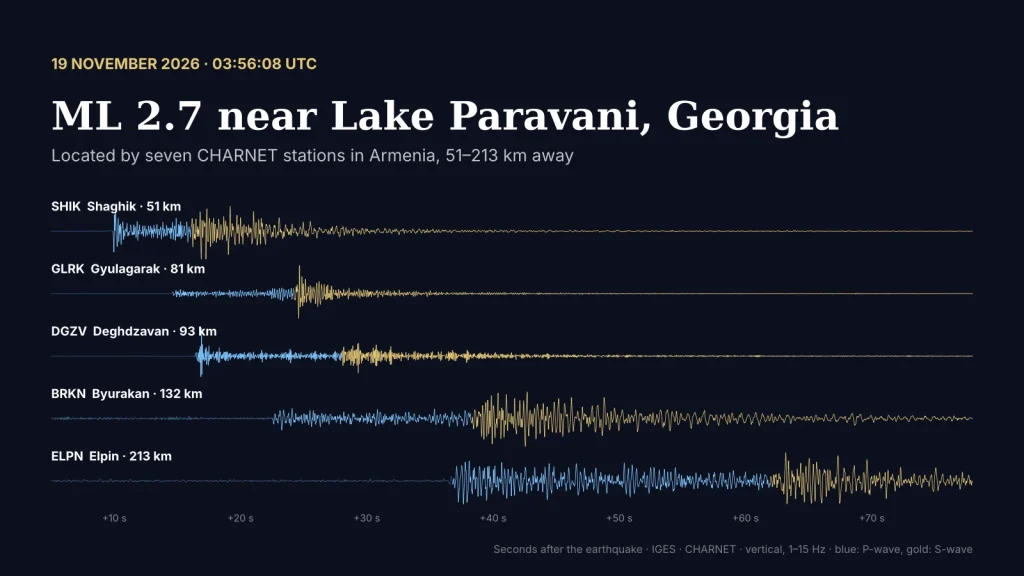
Below are the records of five of the seven stations, from the nearest to the farthest. The two stations in the Gyumri area also recorded the earthquake, but with more background noise, so they are not shown. Press play to watch the waves arrive; the Z, N and E buttons switch between the vertical and the two horizontal components. You can also listen to the earthquake as Shaghik recorded it, sped up five times.
1–15 Hz, 75 seconds of record (03:56:10–03:57:25 UTC), shown 4× faster. Blue — the P-wave, gold — the S-wave. Sound: Shaghik station, vertical component, sped up 5 times. Location and magnitude: IGES, CHARNET network, 7 stations.
The Javakheti highland, a volcanic plateau shared by Georgia and Armenia, is one of the seismically active areas of the Lesser Caucasus, and small earthquakes are common there. Our northern stations, Shaghik first of all, record them clearly.
More earthquake sounds recorded by our stations: Listen to the Earth.
Catch the first wave
The same record, drawn by pens on a paper drum. Press the button, wait, and press again the moment the first wave arrives.
Can you catch the moment the earthquake arrives? Seismologists do it every day.