
Central Peru
About 113 km south-south-east of Huánuco · 13,300 km from Armenia
- Date21 November 2026
- Time04:09 Armenian time · 00:09:21 UTC
- MagnitudeM 6.8
- Epicentre10.916° S, 75.989° W · depth 118 km
Location and magnitude: EMSC · Records: CHARNET network, IGES
At 00:09 UTC on 21 November (19:09 on 20 November in Peru, 04:09 in Armenia), an earthquake of magnitude 6.8 occurred in central Peru, about 113 kilometres south-south-east of the city of Huánuco, at a depth of 118 kilometres, according to the EMSC. Armenia is about 13,400 kilometres away, a third of the way around the globe. For more than eighteen minutes our instruments drew a quiet line. Then, at 04:27:58 Armenian time, came a wave that had been to the centre of the planet.
from the earthquake to the first wave
the surface of the inner core
about 37,000 km/h
In the shadow of the core
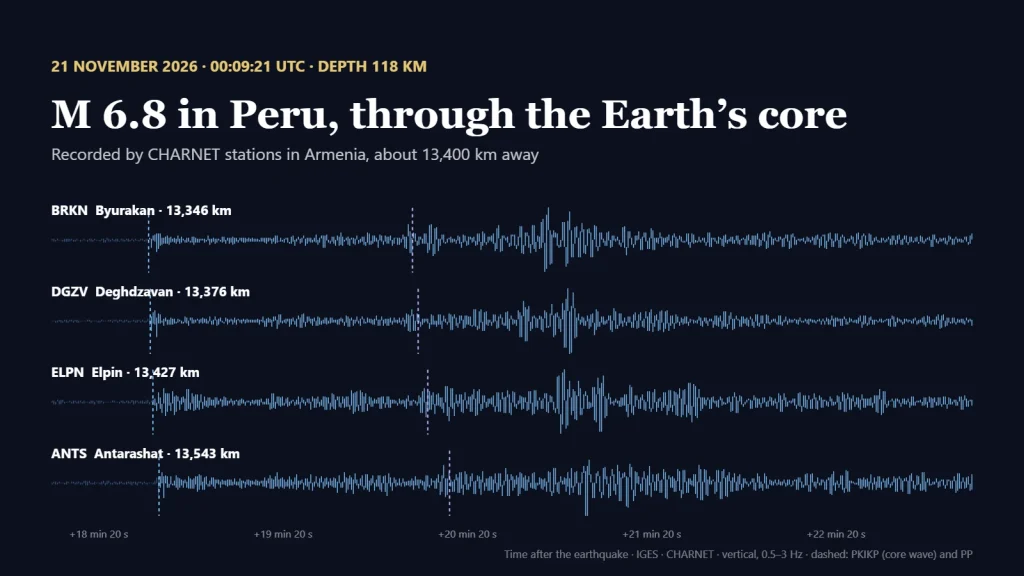
At this distance the direct P-wave cannot arrive. The Earth’s liquid outer core bends seismic waves and casts a “shadow” on the far side of the planet, roughly between 104° and 140° from an earthquake. Armenia, at about 120° from Peru, was deep inside it. What our stations recorded first is a wave that went down through the mantle, crossed the liquid outer core, touched the solid inner core 5,150 kilometres below the surface and came up again under the Caucasus. Seismologists call it PKIKP. Of its 18 and a half minutes of travel, almost ten were spent inside the liquid core.
Almost straight up from below
A wave from a nearby earthquake crosses Armenia sideways, at 6 to 8 kilometres per second. This one came up almost vertically, only about 6° from the vertical, so it reached the whole country nearly at once: by calculation, Antarashat in Syunik, 200 kilometres farther from Peru than Byurakan, received it just 3.4 seconds later. That is as if the wave front swept across Armenia at 58 kilometres per second.
A bounce in the middle of the Atlantic
About a minute and a half after the core wave came PP: a wave that stayed in the mantle and reached Armenia in two jumps, bouncing once off the Earth’s surface halfway. The bounce point lies in the middle of the North Atlantic, roughly a thousand kilometres west of the Canary Islands. Within a minute after PP comes the strongest motion of the record.
Echoes that measure depth
Because the earthquake was 118 kilometres deep, every wave has an “echo”: a copy that first went up to the surface above the source, was reflected there and only then set off on the same journey. For this earthquake the echoes follow about half a minute behind. The delay between a wave and its echo is one of the most reliable ways to measure how deep an earthquake was.
The clue Inge Lehmann used
Weak waves arriving inside the shadow, where none were expected, are how the inner core was discovered: in 1936 the Danish seismologist Inge Lehmann concluded from them that the Earth has a solid inner core inside the liquid one. Ninety years later, four stations in Armenia recorded the same kind of wave. At Byurakan, Deghdzavan, Elpin and Antarashat it arrived within about one second of the time calculated for a standard model of the Earth.
Below are the records of these four stations. Press play to watch the waves arrive; the Z, N and E buttons switch between the vertical and the two horizontal components. You can also listen to the record of Deghdzavan, sped up 75 times.
0.5–3 Hz, 300 seconds of record (00:27:26–00:32:26 UTC), shown 10× faster. The marks are the arrival times of PKIKP and PP calculated for the IASP91 Earth model. Sound: Deghdzavan station, vertical component, played 75× faster. Location and magnitude: EMSC.
And where are the S-waves?
They come later and with much longer periods, so they are almost invisible in the record above. In the long-period band, at periods of 7 to 30 seconds, they stand out. About 27 minutes and 40 seconds after the earthquake comes Sdiff, an S-wave that travelled along the boundary of the core: a sharp pulse, clearest on the north–south component. At about 36 minutes comes SS, an S-wave reflected once from the Earth’s surface on the way. Press N in the record below to see them best.
0.03–0.15 Hz (periods of 7–30 s), 25 minutes of record (00:27:20–00:52:20 UTC), shown 60× faster. The marks are the arrival times of PP, Sdiff and SS calculated for the IASP91 Earth model. The surface waves arrive after the end of this record.
Earthquakes at such depths in Peru occur inside the Nazca plate, which sinks beneath South America. Waves from strong distant earthquakes like this one pass through the whole planet, and every record of them, including ours, carries information about the Earth’s deep interior.
More earthquake sounds recorded by our stations: Listen to the Earth.