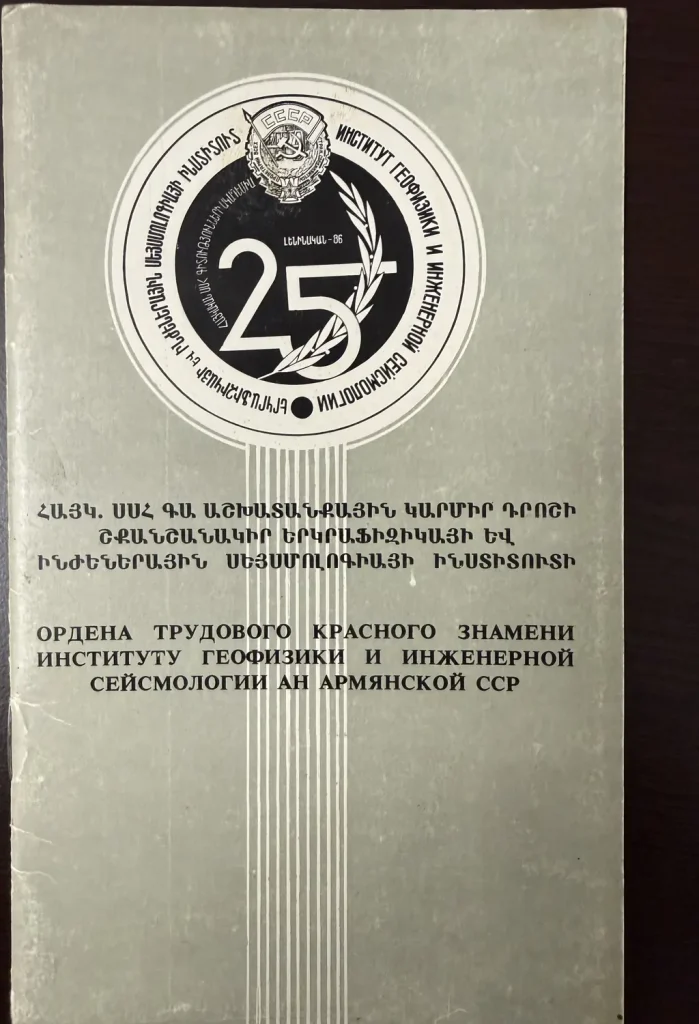
IGES at 25: a booklet from 1986
Anniversary booklet · Academy of Sciences of the Armenian SSR · in Armenian and Russian
- Researchersover 100
- Laboratories8
- Monographs, 1961–198637
An original copy is kept at IGES
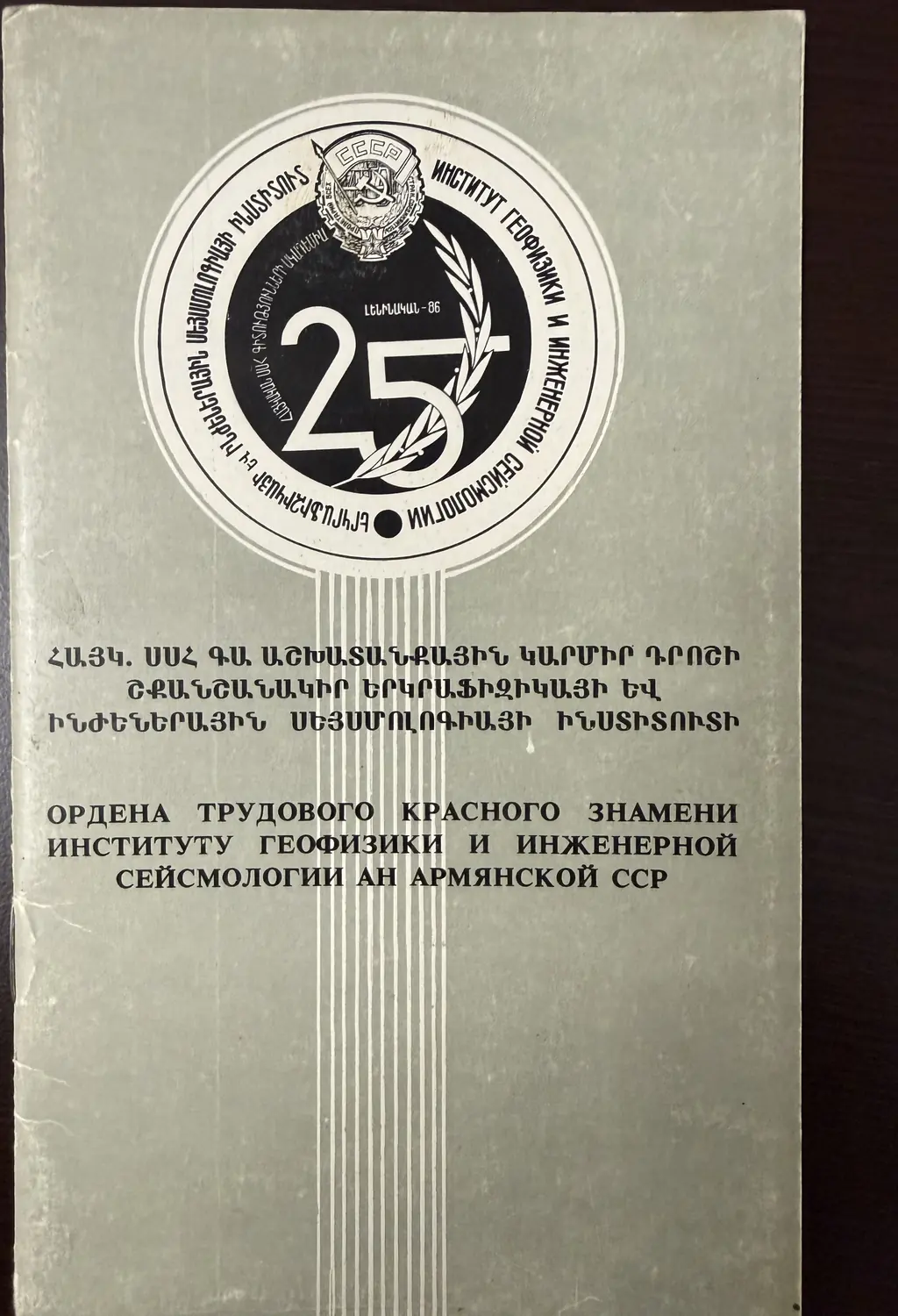
In the institute archive we have found a small booklet printed for the 25th anniversary of IGES in 1986. Its cover carries the anniversary emblem with the Order of the Red Banner of Labour, and inside, in Armenian and Russian, the institute tells its own story: how it began, what it studied and who built it.
How it began
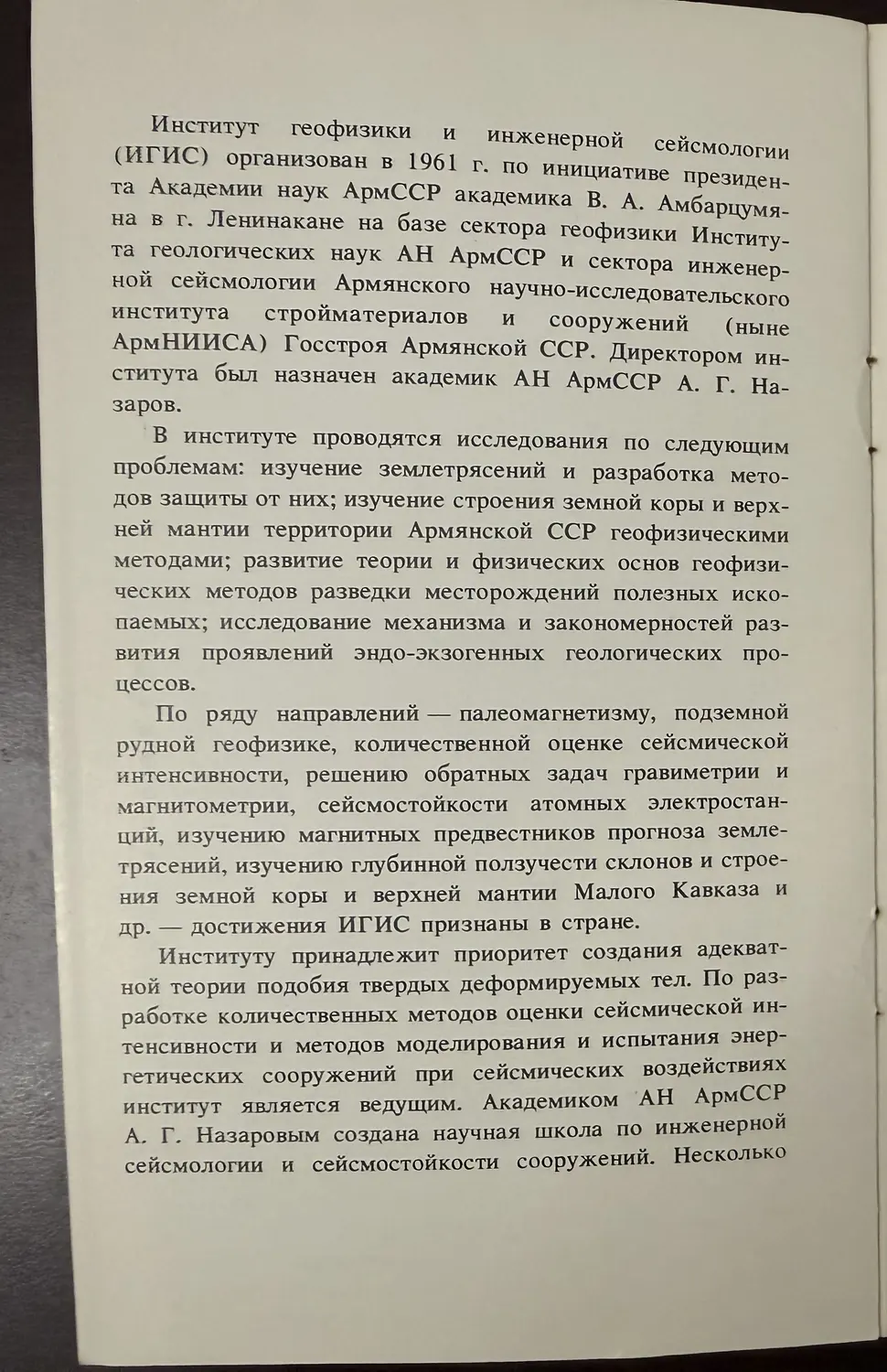
The institute was founded in 1961 in Leninakan, today Gyumri, on the initiative of Viktor Ambartsumian, President of the Academy of Sciences of Armenia. It grew from two groups: the geophysics sector of the Institute of Geological Sciences and the engineering seismology sector of the Armenian research institute of building materials and structures. Academician A. G. Nazarov was appointed its first director.
Schools of thought
Nazarov founded a scientific school of engineering seismology and earthquake-resistant construction; dozens of his students continued his ideas in Armenia and abroad. G. I. Ter-Stepanian created the theory of deep creep of slopes, and Ts. G. Hakobyan founded the Armenian school of palaeomagnetism.
- 1961The institute is founded in Leninakan
- 1964A bulletin on engineering seismology, together with the Tajik institute of seismology
- 1967The series Problems of Geomechanics begins
- 1969The Order of the Red Banner of Labour, 13 March
- 1976A second academic institute in Leninakan grows from the IGES design bureau
- 1979An earthquake prediction expedition is formed on the basis of the seismic network
- 1981A design bureau for a ground and space prediction system opens in Garni
Source: anniversary booklet of IGES, 1986
The institute in 1986
By its 25th year IGES had eight laboratories, from seismology and earth magnetism to seismic hazard and the modelling of seismic processes, together with a geomechanics sector, a computing centre and a design bureau. More than 100 researchers worked on 24 research topics, and about half of them held scientific degrees. From 1961 to 1986 the staff published 37 monographs and 24 collections of papers.
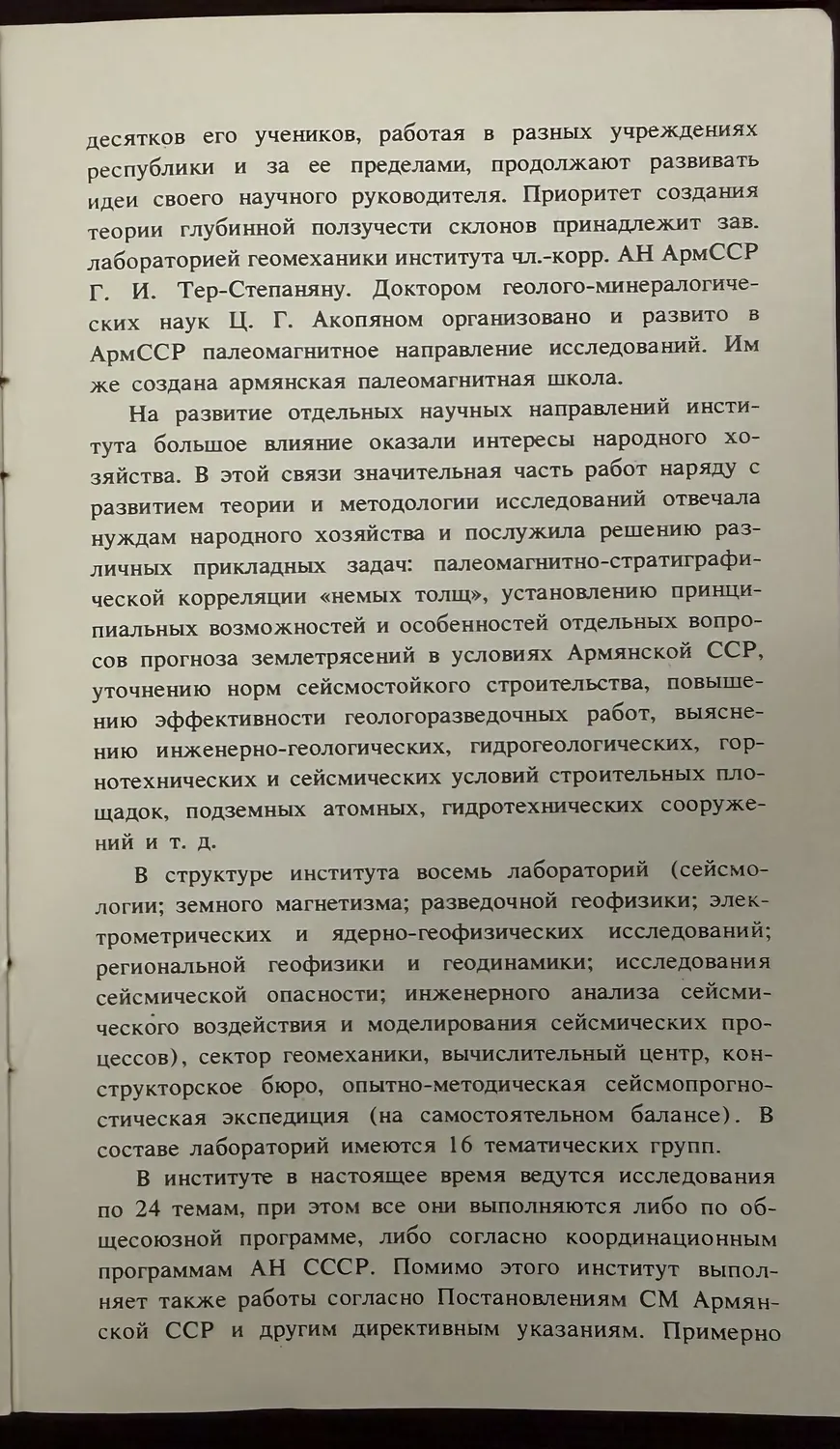
As the leading organisation for earthquake prediction in Armenia, the institute coordinated the work of more than ten organisations and worked with research centres across the Soviet Union.