
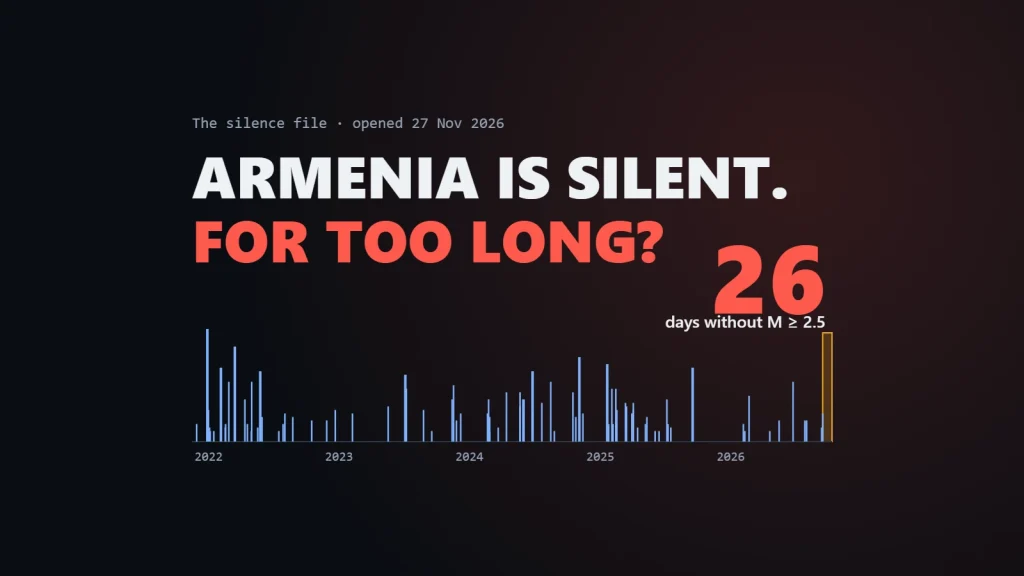
The silence fileopened 27 Nov 2026, 18:20 UTCthe silence continues
Armenia is silent. For too long?
The ground under Armenia shakes almost every week. When it goes quiet, seismologists start counting the days. The evidence is here: 490 earthquakes in and around Armenia since 2012. Change the magnitude threshold and the period, and test the case yourself.
An investigation by IGES
Every shock and every pause
Is the count falling behind schedule?
Has it been this quiet before
Which year was the quietest
Where it is silent and where it still stirs
The longest silences on record
| Days | Began after | Ended with |
|---|
What this file does not prove. Quiescence by itself does not predict an earthquake: long pauses have happened before and ended with ordinary small shocks. This page shows how far the present silence stands out from the past. It does not say what comes next.
How it is counted. A pause is the time between two successive earthquakes at or above the chosen threshold. The current pause runs from the last such event to 27 November 2026, 18:20 UTC, the moment the catalogue was downloaded.
The rate. The expected number of events in the recent months comes from the average rate over the rest of the period. The probability is Poisson: how often the earlier rate would give this many events or fewer by chance. Z is Habermann’s statistic on 30-day bins; above 1.96 the drop in rate is significant at 95 %, above 2.57 at 99 %.
Aftershocks. The checkbox removes events that fall inside the Gardner and Knopoff (1974) window after a larger earthquake: for example, 41 days and 30 km for M 4.0.
Source. Earthquake catalogue: EMSC, through the SeismicPortal event service. Idea, method and analysis: IGES.
Limits. “Armenia” in the EMSC catalogue is a geographic region, not the exact border of the country. Magnitudes are of mixed types (ML, mb, Md). EMSC records small events unevenly, so below a threshold of 2.5 the conclusions are unreliable. A firm conclusion needs the complete catalogue of the IGES network, without gaps.