
Georgia–Azerbaijan border area
East to south-east of Rustavi · about 48 km from our Deghdzavan station
- Date23 November 2026
- Time20:39 local · 16:39:30 UTC
- MagnitudeML 1.6 · Mw 2.4
- Epicentreabout 41.3° N, 45.5° E
Preliminary location by the CHARNET network, IGES · 3 stations
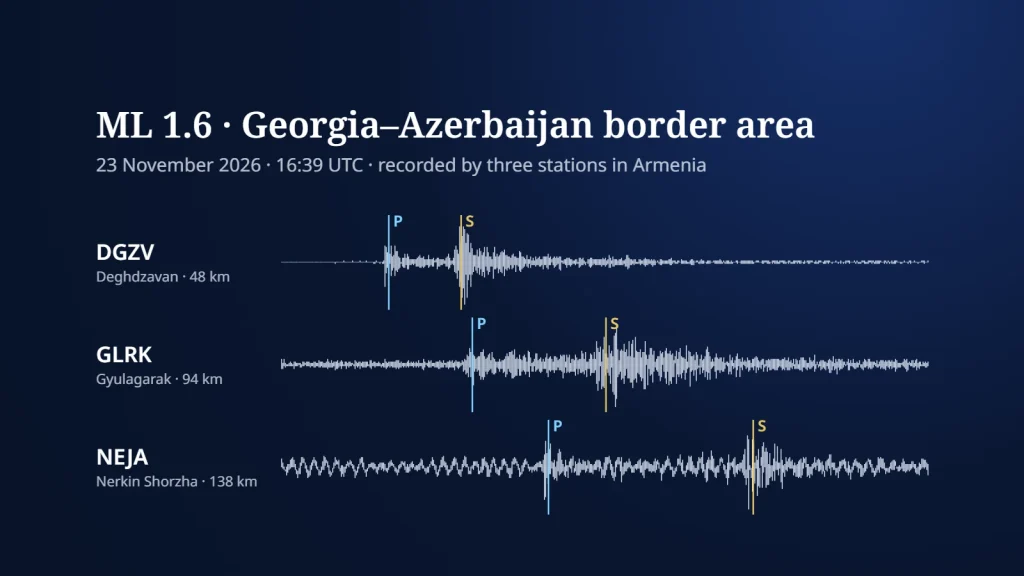
At 20:39 local time on 23 November, a very small earthquake of magnitude ML 1.6 (Mw 2.4) occurred near the border of Georgia and Azerbaijan, east to south-east of Rustavi. Only three CHARNET stations in Armenia recorded it clearly: Deghdzavan, about 48 km away, Gyulagarak, about 94 km away, and Nerkin Shorzha, about 138 km away.
The other six stations of the network are 150 to 240 km from the epicentre. For an earthquake this small, the waves that reach them are weaker than the background noise of the ground, so nothing can be picked on their records. That is normal: the weaker the earthquake, the fewer stations hear it.
The preliminary epicentre (star) and the three CHARNET stations that recorded the earthquake. Hover over a station for its distance and S–P time.
from P-wave to S-wave
from P-wave to S-wave
from P-wave to S-wave
With so few stations, each one counts. Two stations give two distances, and two circles on a map cross at two points, so the epicentre stays ambiguous. The third station, Nerkin Shorzha, the farthest of the three, decides between them: with it the solution moved by almost 30 km and fitted all three records. Even so, the epicentre lies outside our network and all three stations see it from one side, so the location is preliminary. It may shift by 10–20 km, and the depth cannot be determined reliably.
Below are the records of the three stations, from the nearest to the farthest. Press play to watch the waves arrive; the Z, N and E buttons switch between the vertical and the two horizontal components.
1–15 Hz, 55 seconds of record (16:39:30–16:40:25 UTC), shown 4× faster. Blue — the P-wave, gold — the S-wave. Arrival times and magnitude: IGES, CHARNET network. Distances are from the preliminary epicentre.
Small earthquakes beyond our borders, like this one, show where the network hears well and where one more station would help.
Catch the first wave
The same record, drawn by pens on a paper drum. Press the button, wait, and press again the moment the first wave arrives.
Can you catch the moment the earthquake arrives? Seismologists do it every day.