
Northern Qinghai, China
About 320 km south-south-west of Jiayuguan · 4,400 km from Armenia
- Date21 November 2026
- Time14:45 Armenian time · 10:45:33 UTC
- MagnitudeM 5.8
- Epicentre37.222° N, 96.656° E · depth 10 km
Location and magnitude: EMSC · Records: CHARNET network, IGES
At 10:45 UTC on 21 November (18:45 local time, 14:45 in Armenia), an earthquake of magnitude 5.8 occurred in the north of Qinghai province, China, about 320 kilometres south-south-west of the city of Jiayuguan, at a depth of 10 kilometres, according to the EMSC. Seven and a half minutes later its first wave reached Armenia, about 4,400 kilometres to the west, and was recorded across our network. Then, while that wave was still passing, a second, much closer event appeared on the same record.
from the earthquake to the first wave
in the lower mantle
about 35,000 km/h
Down into the lower mantle and back
At this distance, about 40° along the Earth’s surface, the first wave does not travel through the crust. It dives into the mantle, turns at a depth of roughly 950 kilometres and comes back up under the Caucasus at about 26° from the vertical. It reached Antarashat in Syunik, the station closest to China, at 10:53:01 UTC by calculation, and the stations of Shirak, in the north-west, about 14 seconds later: the wave front crossed Armenia from east to west at more than 13 kilometres per second.
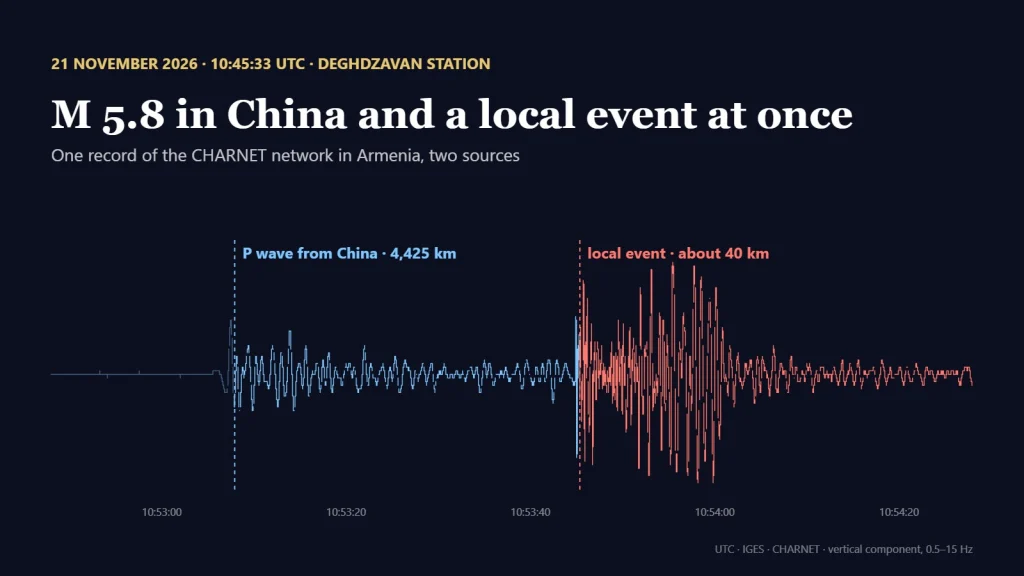
Thirty-seven seconds later, a neighbour
At 10:53:45 UTC, thirty-seven seconds after the wave from China arrived at Deghdzavan station in the north-east of Armenia, a sharp new signal cut into the record. It was a small local event: its S-wave follows its P-wave by only 4.9 seconds, which puts the source about 40 kilometres from the station. Gyulagarak station recorded it too, with 10.5 seconds between the two waves, that is about 85 kilometres away. The other stations, farther off, do not show it clearly. Whether it was a small earthquake or a quarry blast cannot be established from two stations.
How to tell them apart
The two signals look very different, and the reason is distance. Over thousands of kilometres the Earth absorbs the fast vibrations of a seismic wave, so the wave from China arrives as slow swings, below 3 hertz. The local signal has travelled only tens of kilometres and still carries vibrations up to 20 hertz. A simple filter separates them: keep the low frequencies and China remains; keep the high ones and only the neighbour is left.
Deghdzavan station, vertical component, 100 seconds of record (10:52:48–10:54:28 UTC), shown 5× faster; each trace is scaled to its own maximum. The marks are read by hand. On the low-frequency trace the swing near 10:53:57 belongs to the local event.
Below are the records of four stations, from the moment the wave from China arrives. Press play to watch the waves arrive; the Z, N and E buttons switch between the vertical and the two horizontal components. At Deghdzavan and Gyulagarak the local event is marked as well.
0.5–15 Hz, 150 seconds of record (10:52:28–10:54:58 UTC), shown 5× faster; each trace is scaled to its own maximum. The P mark is the arrival time calculated for the IASP91 Earth model; on the records the wave is seen 2 to 3 seconds later. The marks of the local event are read by hand. Location and magnitude of the earthquake in China: EMSC.
Northern Qinghai lies on the north-eastern edge of the Tibetan Plateau, one of the most seismically active regions of Asia. For a network like ours, a day such as this is a useful test: the same instruments followed, at the same moment, a wave that had travelled 4,400 kilometres through the lower mantle and a small event next door.
More earthquake sounds and records from our stations: Listen to the Earth.