Innovation
Research results, instruments built in Gyumri and new methods of data analysis: from the Leninakan years to artificial intelligence.
Publications
Papers by the institute’s researchers in the Bulletin of the Seismological Society of America, Earth-Science Reviews, Earthquake Science and other journals, with an interactive list by year and topic.
Instruments made in Gyumri
Nine series of geophysical instruments designed and built at the institute: seismic stations and MEMS accelerometers, IGES-101 and IGES-102 water-level gauges for reservoirs and the Gyumri-01 system for monitoring dams.
AI and big data
Machine learning on the continuous records of the CHARNET network for automatic phase picking, event detection and earthquake catalogues, together with the Institute of Geophysics of the China Earthquake Administration.
Firsts and new ideas
Earthquakes that have not happened yet
To test a building or a dam, engineers need records of the strong shaking expected at the site, and often no such record exists. IGES developed a method that creates synthetic accelerograms whose response spectrum matches the design spectrum of the building code.
Geology and Geophysics of Russian South, 2025 →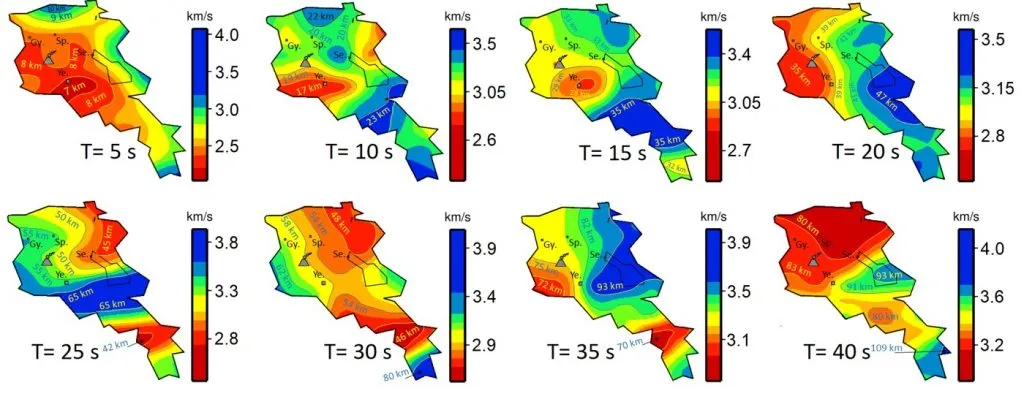 With colleagues from Iran
Seeing under Armenia with earthquake waves
Surface waves from distant earthquakes travel faster through cold, rigid rock and slower through hot, weak rock. Together with the University of Tehran, IGES turned records of 1999–2018 into tomography maps of the crust and upper mantle beneath Armenia and the Caucasus, down to about 180 km, and found hot and cold zones in a series of three papers.
Russian Journal of Earth Sciences, 2022–2025 →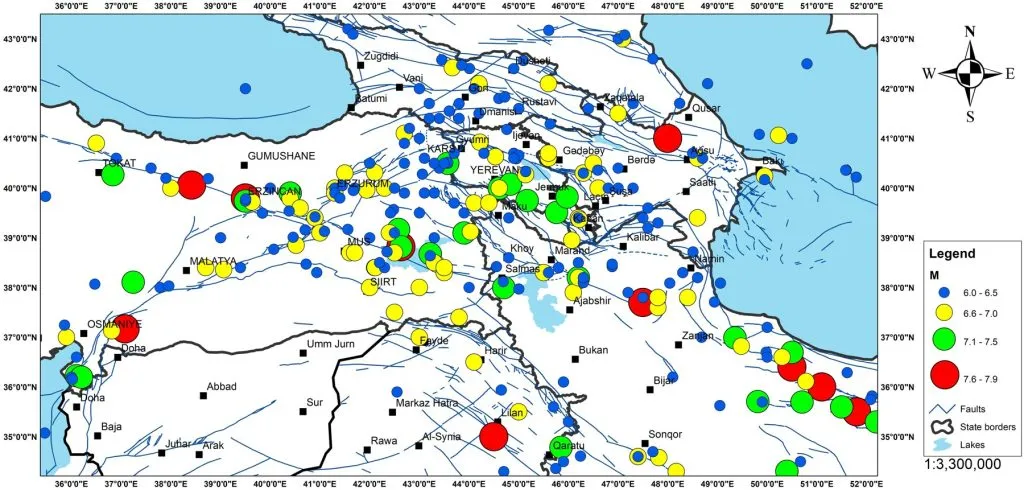 On the cover of BSSA
Strong earthquakes come in pairs
On the map of strong earthquakes of the Tauro-Caucasus, from about 1.8 million years ago to February 2023, almost all epicentres lie on the main faults: 89 events of magnitude 6.0–6.5, 30 of 6.6–7.0, 10 of 7.1–7.5 and 4 of 7.6–7.9. The study shows that strong earthquakes here often occur in pairs within the same source zones, especially at magnitude 6.6–7.0, which matters for long-term forecasting. The joint Armenian–Chinese study was featured on the cover of the Bulletin of the Seismological Society of America.
BSSA, 2024 →Volcano or fault?
Earthquakes beneath a volcanic arc come either from moving faults or from moving magma, and the difference matters. Using the records of our stations, the team told tectonic earthquakes from volcano-tectonic ones in the central Aegean volcanic arc.
Geology and Geophysics of Russian South, 2025 → Built in Armenia
We built the observatories. Now they listen for earthquakes
Over its history IGES, together with partners, built in Armenia a complete set of absolute and variometer magnetic observatories. Today their records are used to look for earthquake precursors: days before earthquakes in Armenia and neighbouring regions, nearby observatories register subtle changes in the magnetic field.
Geomagnetism and Aeronomy, 66(4), 771–781 →How to build a magnetic observatory
How do you measure the Earth’s magnetic field to a fraction of a nanotesla, when even a steel nail in a wall can spoil the record? An international review of the instruments and construction of geomagnetic observatories in Russia and neighbouring countries, with IGES among the authors.
Acta Geodaetica et Geophysica, 2026 →Ash from eruptions millions of years ago
Thin layers of volcanic ash in the Late Miocene rocks of Kakheti, Georgia, keep the memory of ancient eruptions. The study describes their composition and alteration and links them to the volcanic eruptions that produced them.
Russian Journal of Earth Sciences, 2026 →Instruments of the Leninakan years
Seismometers, oscillographs and gravimeters used by the institute in the 1970s and 1980s. Instruments made by its design bureau were shown twice at international exhibitions, in Moscow and in Rome.
Photographs from S. V. Badalyan, «The Institute of Geophysics and Engineering Seismology is 25 years old», Yerevan, 1986. More from the archive →
Instruments developed at IGES
Seismometers, accelerometers and water level meters designed, built and tested at the institute, from the laboratory bench to boreholes, dams and reservoirs.
- 8instruments
- 4patents on seismic sensors
- 3fields of use
Three-component seismometer
Three orthogonal sensors (X, Y, Z) in one housing for recording local and regional earthquakes.
Triaxial accelerometer
Strong-motion sensor for recording ground and building accelerations during earthquakes.
Borehole triaxial accelerometer
Sealed cylindrical version of the accelerometer for installation in boreholes.
Microseismic meter
Portable instrument for measuring microseisms, the ambient vibrations of the ground.
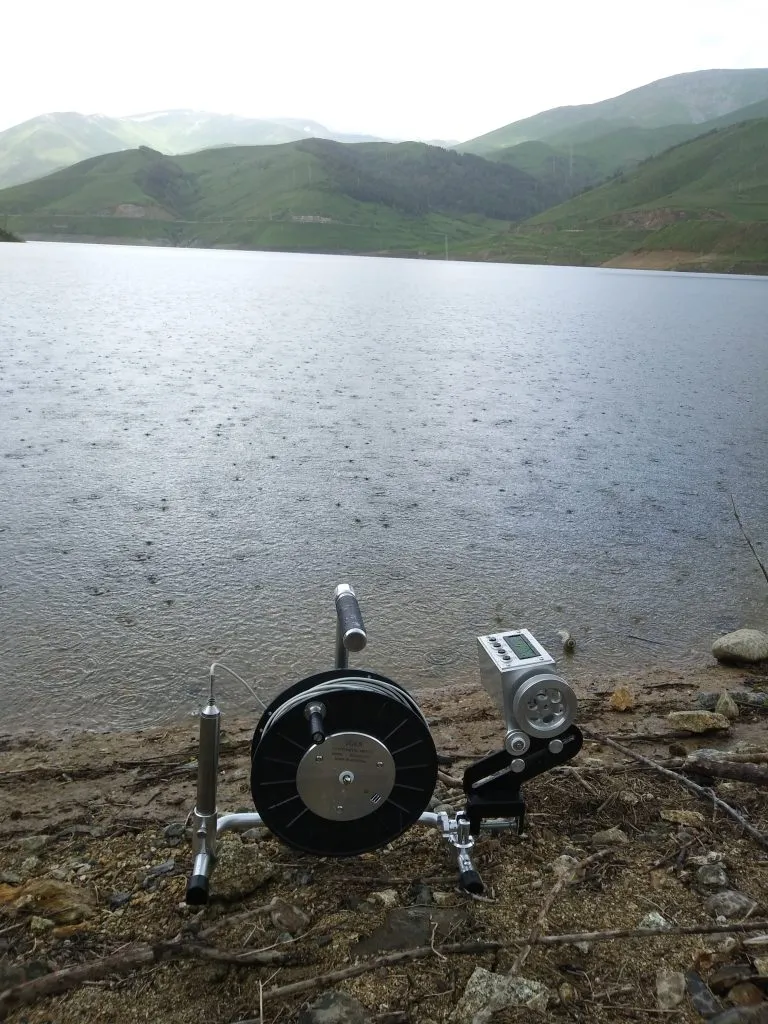
Borehole water level meter
Electric-contact meter with a cable reel, probe and digital counter for wells and boreholes.
Water level meter
Field instrument in a weatherproof housing for water level observations.
Automatic water level recorder
Wall-mounted recorder with display and memory for monitoring reservoirs, lakes and boreholes.
Portable vibration table
Compact shaker with a signal generator and frequency control for teaching structural dynamics.
Need an instrument or a field measurement? Contact the institute →