Western Iran
Kermanshah province, near Javanrud
- Date20 Jul 2026
- 1st shockM 4.9 · 03:43:18 UTC
- 2nd shockM 5.2 · 03:48:51 UTC
- Distance to stations520–760 km
Two earthquakes 5 minutes 32 seconds apart, a few kilometres from each other: a foreshock and a mainshock, or a doublet?
At 03:43 UTC on 20 July 2026 the needles at our stations twitched: an earthquake of magnitude 4.9 had struck western Iran, near the town of Javanrud. Its waves crossed Armenia, the records began to calm down… and then, five and a half minutes later, everything started again. The second shock came from almost the same spot, only about 8 km away (EMSC), and it was stronger: magnitude 5.2.
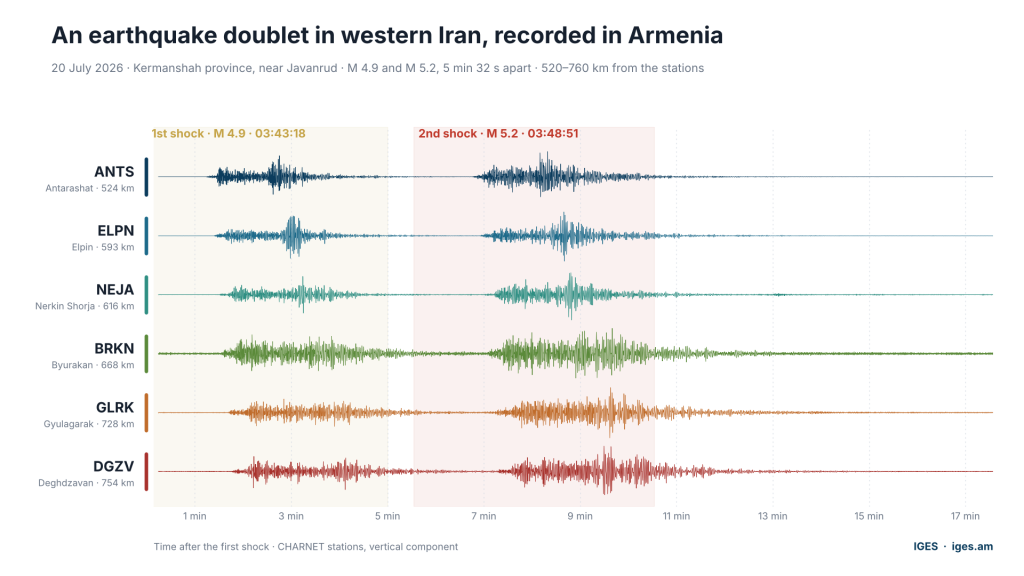
So what was the first shock? A foreshock, a smaller earthquake that announces the main one? Or a twin, an equal partner in a doublet? The magnitudes differ by only 0.3, within the uncertainty of the estimates, and on our records the two look almost identical: at every station the second shock is between 0.8 and 1.1 times as strong as the first. Pairs like this remain one of the puzzles of earthquake science. Watch how both of them arrive in Armenia, 520–760 km away.
Vertical component, 0.5–8 Hz, about 13 minutes of record (03:44:23–03:57:43 UTC), shown 15× faster. First shock: blue P- and gold S-waves; second shock: violet P₂- and red S₂-waves. Times after the first shock. P arrivals are read from the records; S marks follow the iasp91 travel-time model.
- 1 min 14 sThe P-wave of the first shock, M 4.9, reaches Antarashat, our nearest station, 524 km away
- +32 sIt arrives at Deghdzavan in the north, 230 km farther
- 2–3 minThe stronger S-waves cross Armenia and the records swell
- 5 min 32 sWhile the stations are still calming down, the second shock, M 5.2, strikes in Iran
- 6 min 48 sIts waves reach Armenia and the whole sequence repeats: P, then S, from south to north — the twin of the first record
Event parameters: EMSC · Records: CHARNET, IGES
At every station of the network the arrival times of the two shocks differ by almost exactly 5 minutes 32 seconds, the time between the earthquakes, which confirms that they came from nearly the same place. Why strong earthquakes so often come in pairs, and whether the first can warn of the second, is one of the questions studied at the institute.