The Institute of Geophysics and Engineering Seismology was founded in 1961 in Leninakan, now Gyumri, on the initiative of academicians Viktor Ambartsumian and Armen Nazaryan. For more than six decades it has studied earthquakes and the Earth’s physical fields in one of the most seismically active regions of the Caucasus.
- Founded
- 1961, Leninakan (now Gyumri)
- Founders
- Academicians V. A. Ambartsumian and A. G. Nazaryan
- Field
- Geophysics, engineering seismology, earthquake monitoring
Key dates
- 1959The Institute of Geophysics in Beijing orders 20 multi-pendulum seismometers designed by Armen Nazaryan.
- 1961The institute is founded in Leninakan as part of the Academy of Sciences of the Armenian SSR. Academician Armen Nazaryan becomes its first director and leads it for many years.
- 1961In October a session of the Seismology Council of the USSR Academy of Sciences meets in Yerevan and Leninakan and sets up the Commission on Engineering Seismology, chaired by A. G. Nazaryan with B. K. Karapetyan as secretary.
- 1963The staff grows from 43 to 79 people. A department of ore geophysics is created.
- 1966A computer centre is set up, and the seismic stations of Armenia are joined into a single system run by the institute.
- 1968After the Zangezur earthquake the institute begins a systematic search for earthquake precursors. The Kajaran and Karmrakar stations open.
- 1969On 13 March the institute is awarded the Order of the Red Banner of Labour Decree of the Presidium of the Supreme Soviet of the USSR
- 1973The Garni geophysical observatory is created, the first unit of an earthquake forecasting service in Armenia.
- 1974A geophysical test site is set up near the village of Gyulagarak, where the institute’s magnetic observatory stands today.
- 1976The institute’s design bureau becomes a separate institute in Leninakan.
- 1978The underground part of the Garni observatory is commissioned; the whole complex is completed in 1983.
- 1986At its 25th anniversary the institute runs 13 seismic and 9 geophysical stations across Armenia.
- 1988The Spitak earthquake destroys the institute’s building; the institute’s own multi-pendulum seismometers record it in Leninakan. Researchers continue their work in temporary premises for about 25 years, until the institute moves into its new building.
- 1989S. M. Hovhannisyan becomes director of the institute and leads it until 2013, through the years after the Spitak earthquake.
- 2013Jon Karapetyan becomes director of the institute.
- 2015The institute moves into its new building in Gyumri. After 27 years in temporary premises following the Spitak earthquake, it has a permanent home again.
- 2018The institute’s delegation, with the National Academy of Sciences and the Science Committee, holds talks in Beijing with the China Earthquake Administration and its Institute of Geophysics. Armenian–Chinese cooperation begins.
- 2019Chinese and Armenian seismologists survey northern Armenia together and choose sites for eight future stations.
- 2020Construction of the Gyulagarak geomagnetic observatory is completed in September.
- 2023Work begins on CHARNET, the China–Armenia seismic, strong-motion and geodynamic network, together with the Institute of Geophysics of the China Earthquake Administration.
- 2024CHARNET becomes a permanent network of nine stations streaming data to the Gyumri data centre.
- 2025The Armenian–Chinese seismic and GNSS network centre opens in Gyumri, with the first earthquake early warning system in the region.
The first 25 years, 1961–1986
The institute’s early history is told in a book written for its 25th anniversary. Its photographs show the people and instruments of the Leninakan years.
Directors of the institute
- A. G. Nazaryanacademician1961–1969, 1971–1973, 1978–1981
- S. G. Shahinyancandidate of technical sciences1969–1971
- S. V. Badalyancandidate of technical sciences1973–1978, from 1981
- S. M. Hovhannisyandirector1989–2013
- Jon Karapetyandirectorsince 2013
Two academicians: the sky and the Earth
The institute was born from an alliance of two academicians. One studied the stars, the other the trembling ground beneath our feet.
Made in Leninakan
The institute did not only study earthquakes, it built the instruments to record them. Its design bureau created seismometers, recorders, an ocean-bottom seismograph and a system that shuts down power plants in a strong earthquake.
7 December 1988: the earthquake draws its own portrait
During the Spitak earthquake, Nazarov’s multi-pendulum seismometers were working in Leninakan. Each pendulum swings at its own period, and each traced the shaking of the ground on a plate. These tangled loops are a direct picture of how the ground moved at different periods, in three places of the same city.
Did you know?
- The institute was founded not in the capital but in Leninakan. In 1986 it was the largest academic institute in Armenia outside the Yerevan area.
- It started in 1961 with 43 people, a four-storey building and 4 hectares of land.
- The first computers of the institute were the Soviet “Minsk-22” and the Armenian “Razdan-2”.
- Instruments made by the institute’s design bureau were shown twice at international exhibitions, in Moscow and in Rome.
- The Garni observatory was built underground and was meant to collect data by space communication.
- The institute compiled an album of accelerograms of 200 earthquakes from around the world.
- In the laboratory a model of a large-block house was shaken at one third of its real size.
- Measurements of the Earth’s electric and magnetic fields found conducting layers as deep as 450 km.

Source: S. V. Badalyan, «The Institute of Geophysics and Engineering Seismology is 25 years old». Yerevan: Publishing House of the Academy of Sciences of the Armenian SSR, 1986. Photographs from the book.
Founder
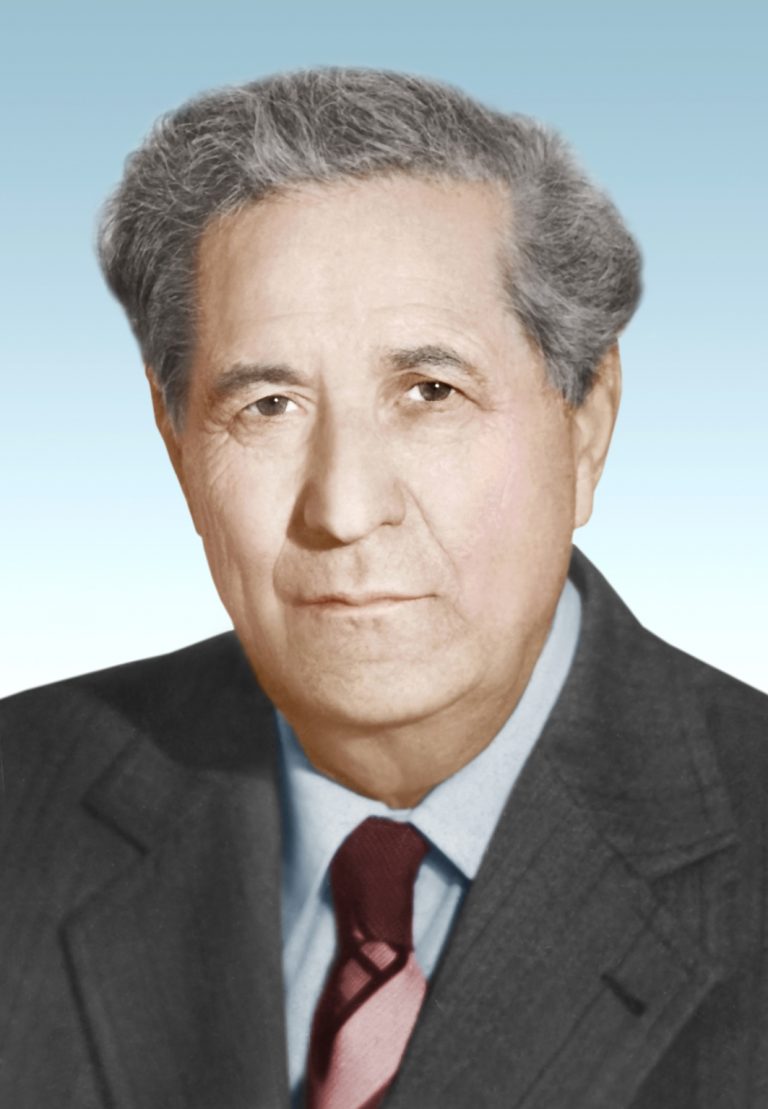
Armen G. Nazaryan
1908–1983, academician of the Academy of Sciences of Armenia
Born in Paris in 1908, Armen Nazaryan grew up and studied in Tbilisi, where he graduated from the Industrial Institute. His first papers, published in 1931, dealt with the vibration of structures during earthquakes, and earthquake-resistant construction remained at the centre of his work for five decades.
Together with K. S. Zavriev he extended dynamic methods of seismic analysis to complex structures. In his 1945 doctoral dissertation he proposed a spectral method for determining the seismic forces acting on buildings. From 1946 he worked in Yerevan as director and deputy director for research of the Armenian Research Institute of Building Materials and Structures, and taught earthquake engineering as a professor at the Yerevan Polytechnic Institute.
In 1961, with Viktor Ambartsumian, he founded the Institute of Geophysics and Engineering Seismology in Leninakan and led it for many years. Under his leadership the institute received the Order of the Red Banner of Labour. He chaired the Commission on Engineering Seismology of the USSR Academy of Sciences and, from 1981 to 1983, headed the Earth Sciences Division of the Academy of Sciences of Armenia. The institute bears his name.
- 150+
- scientific works, including 10 monographs
- 1945
- spectral method of seismic analysis
- 1960
- elected academician
- 1961
- founded the institute in Gyumri
He presented his work at international conferences in
- Madrid 1959
- Tokyo 1960
- Wellington 1965
- Santiago 1969
- London 1970
- Rome 1973
- Istanbul 1975
Selected monographs
- Method of Engineering Analysis of Seismic Forces1956, second edition 1959
- On the Mechanical Similarity of Solid Deformable Bodies: towards a theory of modelling1965
- Fundamentals of the Quantitative Determination of the Intensity of Strong Earthquakes1974, with S. S. Darbinyan
- Elements of Transfinite Analysis
The first seismometer in the Caucasus
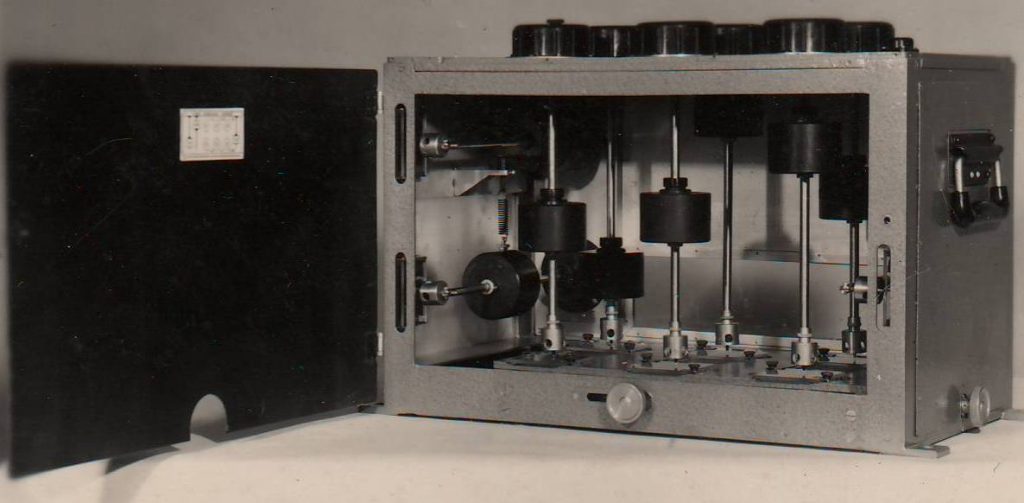
See the original. The first multi-pendulum seismometer designed by Armen Nazaryan is kept in the institute’s museum in Gyumri, together with the story of the 1988 earthquake. Spitak, 1988 →